Updates

Banking Department and Bureau of Loans

AILA Members and Friends:

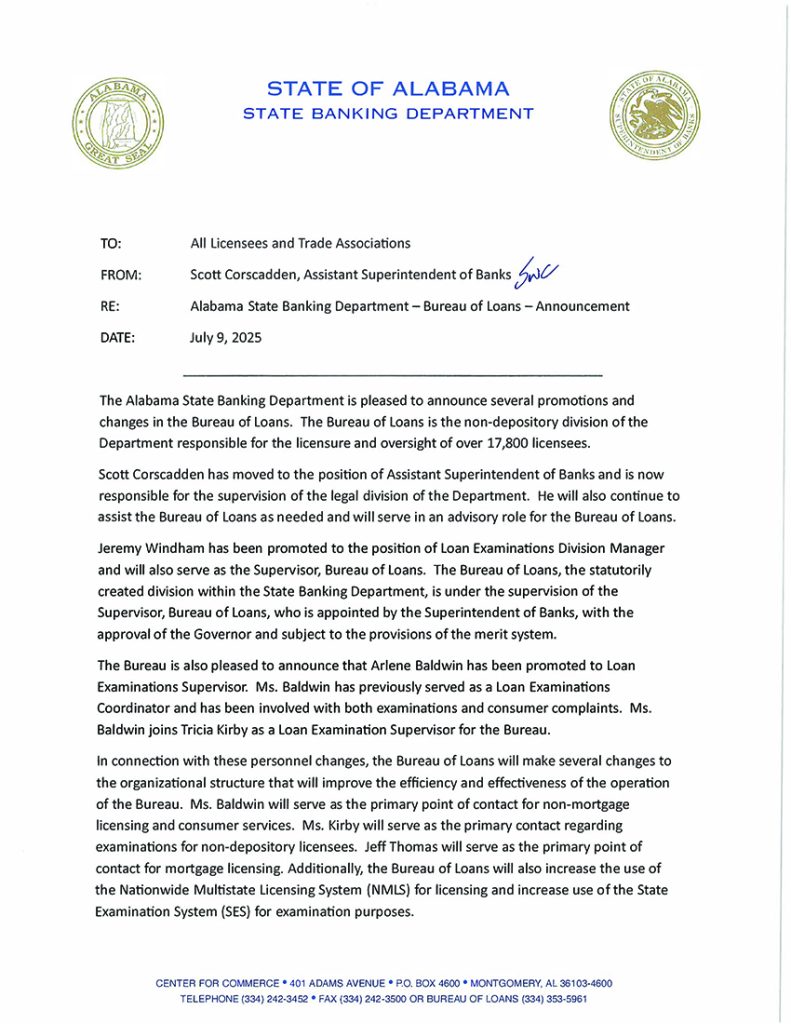
Licensees were sent the attached announcement from the Bureau of Loans this week.  I trust that you received a copy. The Banking Department and Bureau of Loans have been considering this shifting of personnel for some time and have now made the announcement.

From the viewpoint of Licensees, it should be noted that none of the personnel are new to the Department.  All have long experience and know consumer finance.  Jeremy Windham, who will take Scott Corscadden’s position as Supervisor of the Bureau of Loans, has been working with Scott for years—primarily in the Deferred Presentment and Mortgage Lending space—but also in traditional installment lending.   Ms. Baldwin and Ms. Kirby are also well known to us.

We have enjoyed a great working relationship with the Department and Bureau, and I know that this will continue.  We congratulate the members of the Department who have been elevated to their new positions of responsibility, and we pledge to work collaboratively with all to keep our relationship secure.

Maury

CFPB Issues Proposed Rule to Prohibit Certain Terms and Conditions in Agreements for Consumer Financial Products or Services

ILA Members and Friends:  Today, the CFPB issued a proposed rule essentially codifying the Credit Practices Rule with regard to all “covered persons.”  2025-00633.pdf.

The proposal does include something new and different from the Credit Practices Rule:  A new Subpart C, Section 1027.301—Prohibited terms and conditions—will forbid covered persons from including in their consumer contracts any terms or conditions:

  • That purport to waive substantive legal rights and protections
  • That reserves the right to unilaterally amend a material term of the contract, or
  • That restrain a consumer’s lawful free expression.

The CFPB has concluded that use of these types of provisions constitutes an unfair or deceptive act or practice.

The CFPB does not anticipate that this provision of the proposed rule will have a substantial, material effect on the market as covered persons are already likely to be in compliance with these prohibitions.  I concur, at least for Alabama licensees.  Our installment lenders have long been subject to the FTC Credit Practices Rule; and  as to the Subparts’ restrictions and prohibitions, in my years in consumer finance law, it has been my experience that the use of waivers has always been restricted by other applicable state and federal law; and, I’ve never seen an Alabama contract form purporting to allow unilateral amendments nor have I ever seen language purporting to restrain a consumer’s “expressions.”

So, whether this proposed rule does or does not survive the change in Administrations, I think that it will have no material impact on traditional Alabama installment lenders.

In any event, the proposed rule is open for comment until April Fool’s Day, 2025.

-Maury

CFPB Kicks Off Rulemaking to Help Mitigate the Financial Consequences of Domestic Violence and Elder Abuse

AILA Members and Friends:

You may find the link below interesting.  The CFPB has announced proposed rulemaking to address reported harmful effects of inaccurate credit reporting affecting survivors of domestic violence, elder abuse, and other forms of financial abuse. The Bureau is issuing this advance notice of proposed rulemaking to gather additional public input on potential amendments to the regulation—Regulation V—that implements the Fair Credit Reporting Act (FCRA).

CFPB Kicks Off Rulemaking to Help Mitigate the Financial Consequences of Domestic Violence and Elder Abuse | Consumer Financial Protection Bureau

In my judgment, this effort will be one of many that will not survive a change in Administration after January 20th.

Maury

CFPB Payday, Vehicle Title, and Certain High-Cost Installment Loans Rule; Leveraged Payment Mechanism.

At our AILA Committee Day Meeting on October 9, 2024, we had a spirited discussion of the upcoming CFPB Payday, Vehicle Title, and Certain High-Cost Installment Loans Rule. More specifically, we focused on “leveraged payment mechanisms” and just what that entails. My primary focus for the years that I have been talking about this Rule has been to explain to traditional installment lenders how not to become subject to it even if their loans exceed 36% APR. Certainly, the final version of the Rule is simpler for those subject to it. If an installment lender or credit seller decides to use a “leveraged payment mechanism” in connection with a traditional credit loan/sale in excess of 36% APR, then the creditor is subject to the regulation. So, the definition of “leveraged payment mechanism” becomes exceedingly important to this discussion.

A leveraged payment mechanism in a consumer transaction exists if a creditor has the right to initiate a transfer of money, through any means, from a consumer’s account to satisfy an obligation on a loan, except that the lender or service provider does not obtain a leveraged payment mechanism by initiating a single immediate payment transfer at the consumer’s request. There has been considerable discussion over the meaning of the last phrase—”initiating a single immediate payment transfer at the consumer’s request.” My understanding is that if a creditor can “pull” funds—e.g. transfer from a consumer’s account by means of a check, an ACH, or a remotely created check without the consumer taking further action—then the creditor enjoys a leveraged payment mechanism. However, if the consumer must “push” funds by using his or her bank’s online banking services or by giving a single, immediate instruction to the creditor to “pull” funds, then that is not a leveraged payment mechanism. “Immediate” is defined to mean within one business day of receipt of a consumer’s authorization for a one-time transfer.

Examples of situations in which a lender obtains a leveraged payment mechanism include:

1. Future authorization—the loan agreement provides that the consumer, at some future date,
must authorize the lender or service provider to debit the consumer’s account on a recurring
basis.

2. Delinquency or default provisions. The loan agreement provides that the consumer must authorize the lender or service provider to debit the consumer’s account on a one-time or a recurring basis if the consumer becomes delinquent or defaults on the loan.

3. When a lender has the current ability to initiate a transfer of money from a consumer’s account whether by a check, draft, EFT or remotely created check.

Clearly, it is incumbent on lenders to check their documents carefully to make certain that the language used in the forms do not inadvertently create your right to a leveraged payment, unless that is indeed, what you intend. And, if so, then you must be prepared to comply with the “covered loan” requirements.

Respectfully submitted,
Maury Shevin

The CFPB and You

AILA Members and Friends:

This summer, I’ve been speaking and writing on CFPB Rule making developments.  For better or worse, the Bureau has been exceedingly active in its efforts.

Recent CFPB rulemaking or studies include:

  • A new interpretive rule aimed at lenders to the Buy Now, Pay Later industry.
  • A new registry to detect corporate repeat offenders of financial services laws.
  • A continuing focus on military community complaints.
  • A finalization of Regulation F applicable to debt collectors.
  • Finalizing the Payday Lending Rule to take effect on March 30, 2025.
  • A new report on negative equity lending in auto financing.
  • A proposed rule to clarify that the “earned wage access product” is to be considered a loan.


And atop all of this activity, is the unpredictable consequences of last month’s U.S. Supreme Court decisions in Loper Bright Enterprises v. Raimond and Relentless, Inc. v. Department of Commerce.  These twin decisions overturned the 40-year precedent of Chevron USA Inc. v. Natural Resources Defense Council—the case that created a deferential review in favor of the regulator, commonly known as the “Chevron Doctrine.”  While this may not seem so important to non-lawyers, the significance of overturning Chevron cannot be overstated.

In a nutshell, what the Court has done in Loper Bright Enterprises, is to return the review of an agency’s rulemaking to “independent judicial review” that does not defer to a federal agency’s determination of the reasonableness of the rulemaking.   The import of this case goes far beyond the rulemaking by the CFPB as it applies to all agencies and bureaus of the federal government from the most prominent to the most obscure—a vast number of players affecting our everyday lives—think the IRS, the EPA, the FED, the FTC, the Consumer Products Safety Commission, the Centers for Disease Control—as well as the National Marine Fisheries Service.

My counsel for you is that if you have a child or grandchild considering law school, I’d encourage them to go and to specialize in regulatory law, as that part of the law is going to burgeon in the coming years!

Stay tuned.

Maury

Safeguards Rule – Data Breach Reporting Requirements.

AILA Members and Friends:

At the end of October, the Federal Trade Commission (FTC) made further amendments to the Gramm-Leach-Bliley Act (GLBA) Safeguards Rule that will require self-reporting in the event of certain data breaches. Read the official press release from the FTC here: FTC Amends Safeguards Rule to Require Non-Banking Financial Institutions to Report Data Security Breaches | Federal Trade Commission.

As we wrote on our blog and discussed at our annual convention, over the last few years, the FTC has amended, expanded and modernized the GLBA Safeguards Rule. The Safeguards Rule requires financial institutions to implement a written policy (called an information security program) designed to safeguard customer information. By now, all consumer finance companies should have reviewed and updated their policies in response to the revisions to the Rule.

Just last month, the FTC announced further changes to the Safeguards Rule. Under these new amendments, non-bank financial institutions must notify the FTC as soon as possible (but no more than 30 days) after discovery of a security breach involving unencrypted information of at least 500 consumers. There are specifics in the Rule about what type of breach triggers the notice requirements and what the notice to the FTC must include. The new provisions will go into effect in about 6 months.

Data security is, and continues to be, one of the top priorities of FTC (as well as the CFPB), so to protect your customers and your business, you need to be sure your Safeguards Policy is up-to-date. Also, if you suffer a data breach, you should consult with your compliance team and attorneys to determine whether there are any state or federal reporting requirements.

If you have any questions, let us know.

Samuel Friedman
Shareholder
1-205-930-5140
Birmingham

2023 Legislative Conference & 2023 Annual Convention

AILA Members:  Please mark your calendars now for two upcoming events that have become hallmarks of our Association:

First, our 2023 Legislative Conference will occur Tuesday, March 21st, in Montgomery, AL.  This is our annual opportunity to catch up with our Legislators and their staff at the beginning of each year’s legislative session.  The reception following our meeting, gives us the opportunity to speak to our legislators while topics and issues facing our Industry may be brewing.

Second, our 2023 Annual Convention will begin Thursday, June 15th, in Biloxi, MS.  We will be at the Beau Rivage Hotel & Casino this summer.  This is the meeting where we discuss developments important to the consumer finance industry, and where we get critical one-on-one time with our Legislators and their families.  This annual event has done more to cement a great working relationship with our Legislators than anything else we can do as an Association.  Registration details about the Convention will be coming soon.

Please attend both if you possibly can!  I look forward to seeing you soon.

-Maury

Inflation Reduction Act of 2022

AILA Members and Friends: One benefit of being part of the world’s largest law firm, is to find expertise everywhere throughout our firm!

My partners have put together a readable summary of the recently enacted Inflation Reduction Act of 2022. I pass it along to you in case you are interested.

-Maury

August 10, 2022

On Sunday, August 7, 2022, after a rare and grueling weekend session with nearly 16 hours of voting on amendments, the US Senate passed H.R. 5376, the Inflation Reduction Act of 2022 (IR Act) by a partisan 50-50 vote, with Vice President Kamala Harris breaking the tie in favor of the bill. The House is expected to return early from recess and consider the measure on Friday, August 12.

The IR Act, if approved by the House, represents a major victory for congressional Democrats heading into the November midterm elections.

READ THE COMPLETE ARTICLE

A Message From AILA President Shane Turner!

Good morning everyone,

I am pleased to report that Governor Ivey has signed HB335, now Act #2022-207, a copy of which is attached. The Act is now effective to allow a closing fee on loans made under the “Alternate Rate” (section 5-18-15(m)) of the Alabama Small Loan Act. The closing fee allows for a 4% fee up to $50 on loans made under the “Alternate Rate” up to $1500. Below is the bill language.

(7) In addition to the acquisition charge provided under subsection (m) (l), the licensee may collect a closing fee in an amount not to exceed the lessor of four percent of the loan amount or fifty dollars $50. The closing fee may be paid from the proceeds of the loan and financed by the licensee.

(8) Upon the prepayment in full of any loan under this subsection, any closing fee collected shall be subject to subsection (d), as it relates to refunds, provided, however, that the licensee may retain up to twenty-five dollars $25 of the closing fee. 

The Act specifically provides that it applies to loan contracts entered into after the effective date, which is immediately following approval by the Governor.  In other words, the Act is now law.

Our Alabama Small Loan Act licensees owe a great debt of gratitude for all of the hard work by legislators and our professionals and volunteers who have spent long hours in this legislative session in Montgomery. First and foremost, we thank Rep. Chris Blackshear and Senator Will Barfoot for their leadership in drafting and shepherding the bill through the House and Senate. Our House vote was 73-13, and in the Senate, it passed 32-0. I also want to recognize our outstanding lobbying team of John & Tami Teague and Jerry Spencer. Our member volunteers on the ground were spearheaded by myself and Whit Wright.  Jim Rawls, Kevin Gardner, Gene Smith,  Brenda Ford, Holly Munoz, and Rick Davis were also there to help. And, thanks to all of the member companies that helped financially.

A great Team is needed to make things happen. I want to thank everyone that helped with this legislation.

Click Here For A Copy of Act #2022-207

Sincerely,

Shane Turner

May 20, 2020

AILA Members and Friends: Please find below a message sent out today from the American Financial Services Association that addresses Paycheck Protection Program loan uncertainty. Thanks to our friends at AFSA for keeping us up to date on developments. Please let me know if you have any questions.

Maury

AFSA is continually updating its Coronavirus Resource Page with Federal / State Government Affairs materials, including maps, policy updates and federal and state guidance. Please check back often. If you require additional information, contact Dan Bucherer at dbucherer@afsamail.org.

Some Legal Clarity on PPP Loans?

With the uncertainty around the Small Business Administration’s (SBA) Paycheck Protection Program (PPP) and the extra scrutiny that the Administration has promised, we understand that some members may be considering returning the funds they received.

While AFSA doesn’t offer legal advice and you should consult your own attorneys, you may want to review a recent decision out of a U.S. district court in Michigan before doing so. The court issued a preliminary injunction barring the SBA from enforcing a rule to exclude businesses that present live performances or sell products of a “prurient sexual nature” from loans under the PPP. While that’s obviously not the business that AFSA members are engaged in, the judge also said the SBA cannot exclude other businesses, i.e. banks, because Congress intended to support all qualified small businesses, including those it might have “disfavored” before the coronavirus hit.

The ruling can be reviewed here. The district court noted that, “The COVID-19 pandemic has decimated the country’s economy, and the PPP is an unprecedented effort to undo that financial ruin. More importantly, the PPP is an effort to protect American workers … and Congress could rationally have concluded that those workers need protection no matter the line of business in which they work.”

The ruling goes on: “[T]he text of the PPP makes clear that every business concern meeting the statutory criteria is eligible for a PPP loan during the covered period. Congress identified in the PPP only two criteria that a business concern must satisfy in order to qualify for loan guarantee eligibility: (1) during the covered period (2) it must have less than 500 employees or less than the size standard in number of employees established by the Administration for the industry in which the business operates.” U.S. District Judge Matthew Leitman wrote, adding, “Simply put, Congress did not pick winners and losers in the PPP…. It would ordinarily be absurd to conclude that Congress meant to provide financial assistance to, among others, certain sexually oriented businesses and private clubs that discriminate. But these are no ordinary times, and the PPP is no ordinary legislation.”

The decision may be appealed, but if it is not, it could provide the clarity that has been lacking in the SBA’s interim rules and FAQs. In addition, we’re awaiting a decision out of another U.S. district court in California. Payday Loan LLC, which engages in lending and check cashing in 22 stores in California, sued the SBA on April 25 after its request for a $644,000 forgivable loan was denied. The application was rejected on the grounds that PPP funds can’t be distributed to companies that profit mostly from making loans. A decision is expected soon.

However, it is unclear whether a decision will come before May 14, which is the date that companies can return PPP loans without paying a penalty. AFSA Staff is pressing the SBA to abandon the May 14 return deadline, or extend it, in light of the ongoing litigation and legislative efforts. Again, in considering your options and the needs of your business, we advise that you discuss these matters with legal counsel, and we will continue to keep you updated. If you have additional questions or concerns, please feel free to contact Celia Winslow at cwinslow@afsamail.org.